This report highlights trends from
February 2019 to
June 2026.
Notice of Brief Formatting and Revision to Previous Data Estimates
For the best viewing experience, please open this PDF in Google Chrome. Some features or formatting may not display correctly in other browsers or PDF viewers.
The data in this brief have been updated to capture new e-cigarette products coded by Circana (formerly IRI). Historical sales estimates may differ from previous briefs.
Federal Regulatory Actions
In February 2020, the U.S. Food and Drug Administration (FDA) began prioritizing enforcement of existing regulations against prefilled e-cigarette cartridges in flavors other than tobacco and menthol. This prioritization did not apply to e-liquid bottles or single-use disposable e-cigarettes. Since February 2020, sales of disposable e-cigarettes have increased markedly.
FDA began issuing marketing denial orders for flavored e-cigarette products as of August 26, 2021.
As of May 2026, FDA has authorized 45 e-cigarette products to be marketed in the United States.1 Only these products may be lawfully be sold in the United States.
Beginning April 14, 2022, FDA had the authority to regulate products containing nicotine from any source, including synthetic nicotine.
Key Findings
Total E-Cigarettes:
During the 6-month period ending on March 22, 2026, the total number of e-cigarette products sold in tracked Circana retail sales channels in the United States reached 6,957 products,2 of which 6,548 (94.1%) were disposable e-cigarettes.
From February 2, 2020, to March 22, 2026, total monthly e-cigarette unit sales increased by 18.3% (15.5 million units to 18.3 million units); non-tobacco-flavored e-cigarette sales (mint, menthol, clear/other cooling and other flavors) increased by 31.2% (11.1 million units to 14.6 million units). By March 22, 2026, non-tobacco-flavored e-cigarette sales accounted for 79.4% of total unit sales.
From February 2, 2020, to March 22, 2026, the total amount of e-cigarette nicotine sold per month increased by 206.6% (2.7 billion to 8.2 billion milligrams). This increase was 11.3 times greater than the 18.3% increase in standardized unit sales. (Units of e-cigarettes are not adjusted to account for variations in unit size. Milligrams of nicotine sold, on the other hand, accounts for increases in nicotine strength and the amount of e-liquid in recent disposable e-cigarettes).
The top 10 purchased brands from January 25, 2026, to March 22, 2026, were (in descending order of dollar sales) Vuse, JUUL, Geek Bar Pulse, Breeze Smoke, Foger Switch Pro, Breeze Prime, RAZ, NJOY, HQD and Loon Maxx. The top 5 brands and top 10 brands accounted for 72.0% and 79.9% of total dollar sales, respectively.
Geek Bar Pulse, Foger Switch Pro and RAZ, which ranked among the top ten brands nationally in this data brief, contain product models considered “smart” vapes (vapes that incorporate technologies such as digital screens, animations, interactive notifications and power level/usage indicators).3
The 2025 National Youth Tobacco Survey (NYTS) found that 7.1% (1.13 million) of high school and 2.6% (300,000) of middle school students currently used e-cigarettes. Among those who currently used e-cigarettes, 89.4% used flavored e-cigarettes.4,5
Flavored Disposable E-Cigarettes:
From February 2, 2020, to March 22, 2026, disposable e-cigarette sales increased by 163.1% (4.0 million units to 10.6 million units); their unit share increased from 25.9% to 57.7% of total e-cigarette sales. As of March 22, 2026, 91.6% of disposable e-cigarette unit sales were of non-tobacco flavors.
Among youth who used e-cigarettes in 2025, 66.3% used disposable e-cigarettes (NYTS).5
Menthol-flavored E-Cigarettes:
From February 2, 2020, to March 22, 2026, overall menthol-flavored e-cigarette sales increased by 11.3% (5.1 million units to 5.7 million units). Menthol-flavored cartridge sales increased by 2.3% (4.7 million units to 4.8 million units). As of March 22, 2026, menthol-flavored e-cigarette sales accounted for 30.9% of the overall e-cigarette market and 62.6% of the prefilled cartridge market.
Among youth who used flavored e-cigarettes in 2025, 15.5% used menthol flavor (NYTS).5
Relevant Issues
During 2020–2026, additional flavored tobacco products continued to be marketed (e.g., flavored cigars) or entered the market (e.g., nicotine pouches).
Following California’s prohibition of flavored tobacco product sales in December 2022, sales of products branded as clear, clear ice and unflavored, likely containing non-menthol synthetic cooling agents, increased (e.g., Flum Pebble Clear, EB Design BC5000 Clear). These products are categorized as Clear/Other Cooling in this data brief.
The e-cigarette or vaping product use-associated lung injury (EVALI) outbreak in late 2019 and COVID-19 pandemic may have affected e-cigarette sales.
Conclusion
Restrictions that exempt certain flavors and product types likely shift sales to the products and flavors that remain on the market. Policies that prohibit the sale of all flavored tobacco products, including flavored e-cigarettes, reduce tobacco product sales and use of tobacco products.6
U.S. Food and Drug Administration. Searchable Tobacco Products Database. https://www.accessdata.fda.gov/scripts/searchtobacco/ (accessed May 10, 2026).
Number of e-cigarette products is counted as the number of unique UPCs (Universal Product Codes) in Circana data. Packaging differences (e.g., differing number of cartridges, multi-packs) can result in new UPCs.
Bertrand A, Diaz MC, Goyette R, et al. Tracking technology changes of e-cigarettes: characteristics and capabilities of new smart vape devices. Tobacco Control Published Online First: 17 August 2024. doi: 10.1136/tc-2024-058862.
Bover Manderski MT, Tomaino M, Torres Alvarez R, Meza R, Delnevo CD. Tobacco Product Use among Middle and High School Students — National Youth Tobacco Survey, United States, 2025. CRST-CAsToR Data Brief, 26 March 2026. https://tobaccocrst.org/data-brief
CDC Foundation analysis of NYTS 2025 data.
U.S. Department of Health and Human Services. Eliminating tobacco-related disease and death: addressing disparities—A report of the Surgeon General. Atlanta (GA): U.S. Department of Health and Human Services, Centers for Disease Control and Prevention, National Center for Chronic Disease Prevention and Health Promotion, Office on Smoking and Health; 2024.
National E-Cigarette Unit Sales by Flavor
*
Sales data do not reflect sales from vape shops or online retailers; dates represent end of 4-week periods;
e-cigarette accessories and devices sold without e-liquids were excluded (1.4% of total dollar sales in 2025).
Unit sales were standardized to reflect the most common package size for each product type. A standardized unit
was equal to five prefilled cartridges, one disposable device or one e-liquid bottle.
**
Sales estimates from 2019 reflect preserved data from custom CDC Foundation analyses using archived
Circana data that are no longer updated or included in Circana’s current sales projections.
†
“All other flavors” category includes fruit, clove/spice, chocolate, alcoholic drink (e.g., wine, cognac or
other cocktails), candy/desserts/other sweets, some other flavor; “clear/other cooling” category
includes products with flavor names such as clear, clear ice or unflavored, which likely contain
non-menthol synthetic cooling agents (e.g., Flum Pebble Clear, EB Design BC5000 Clear) and which observe
an increase in sales following California’s flavored tobacco product sales restrictions beginning
December 2022.
Trends of Unit Sales by Flavor Following FDA’s 2020 Flavor Enforcement Policy
From 2/2/2020 to 6/14/2026, unless otherwise specified
Total monthly e-cigarette sales increased from 15.5 million to 19.4 million (+25.2%).
Δ Unit Sales
25.2%
Tobacco-flavored e-cigarette sales decreased from 4.4 million to 3.6 million (-18.0%); unit share decreased from 28.3% to 18.6%.
Δ Unit Sales
-18.0%
Non-tobacco-flavored e-cigarette sales increased from 11.1 million to 15.7 million (+41.4%); unit share increased from 71.7% to 80.9%.
Δ Unit Sales
41.4%
Menthol-flavored e-cigarette sales increased from 5.1 million to 5.7 million (+12.5%); unit share decreased from 32.9% to 29.5%.
Δ Unit Sales
12.5%
Mint-flavored e-cigarette sales increased from 1.4 million to 1.6 million (+10.8%); unit share decreased from 9.1% to 8.0%.
Δ Unit Sales
10.8%
Other-flavored e-cigarette sales increased from 4.6 million to 8.2 million (+77.5%); unit share increased from 29.7% to 42.0%.
Δ Unit Sales
77.5%
Between 12/4/2022 and 6/14/2026 clear/other cooling flavored e-cigarette sales increased from 83.8 thousand to 268.1 thousand (+219.9%); unit share increased from 0.3% to 1.4%.
Δ Unit Sales
219.9%
Retail sales data are based on custom research by the CDC Foundation using Circana retail POS (Multi-Outlet+ and Convenience). Financial support was provided by Bloomberg Philanthropies through a grant to the CDC Foundation. The findings and conclusions in this report are those of the authors and do not necessarily represent the official position of the CDC Foundation. According to Circana, new product coding is managed to consistently meet or exceed releasing products that cover a minimum of 95.5% of total dollar sales at any given time. To account for the remaining share, Circana applies projection algorithms that ensure the released data is representative of both total U.S. and state-level sales.
National E-Cigarette Dollar Sales by Flavor
*
Sales data do not reflect sales from vape shops or online retailers; dates represent end of 4-week periods;
e-cigarette accessories and devices sold without e-liquids were excluded (1.4% of total dollar sales in 2025).
**
Sales estimates from 2019 reflect preserved data from custom CDC Foundation analyses using archived
Circana data that are no longer updated or included in Circana’s current sales projections.
†
“All other flavors” category includes fruit, clove/spice, chocolate, alcoholic drink (e.g., wine, cognac or
other cocktails), candy/desserts/other sweets, some other flavor; “clear/other cooling” category
includes products with flavor names such as clear, clear ice or unflavored, which likely contain
non-menthol synthetic cooling agents (e.g., Flum Pebble Clear, EB Design BC5000 Clear) and which observe
an increase in sales following California’s flavored tobacco product sales restrictions beginning
December 2022.
Trends of Dollar Sales by Flavor Following FDA’s 2020 Flavor Enforcement Policy
From 2/2/2020 to 6/14/2026, unless otherwise specified
Total monthly e-cigarette sales increased from $317.2 million to $478.3 million (+50.8%).
Δ Dollar Sales
50.8%
Tobacco-flavored e-cigarette sales decreased from $99.4 million to $95.6 million (-3.8%); dollar share decreased from 31.3% to 20.0%.
Δ Dollar Sales
-3.8%
Non-tobacco-flavored e-cigarette sales increased from $217.7 million to $380.5 million (+74.7%); dollar share increased from 68.7% to 79.5%.
Δ Dollar Sales
74.7%
Menthol-flavored e-cigarette sales increased from $114.7 million to $178.8 million (+55.9%); dollar share increased from 36.2% to 37.4%.
Δ Dollar Sales
55.9%
Mint-flavored e-cigarette sales decreased from $31.0 million to $28.8 million (-6.9%); dollar share decreased from 9.8% to 6.0%.
Δ Dollar Sales
-6.9%
Other-flavored e-cigarette sales increased from $72.0 million to $168.9 million (+134.7%); dollar share increased from 22.7% to 35.3%.
Δ Dollar Sales
134.7%
Between 12/4/2022 and 6/14/2026 clear/other cooling flavored e-cigarette sales increased from $1.4 million to $3.9 million (+182.7%); dollar share increased from 0.3% to 0.8%.
Δ Dollar Sales
182.7%
Differences between trends in unit sales and dollar sales could be due, in part, to inflation and the recent increase in large-format disposable e-cigarettes that allow for thousands of puffs. Higher price per device of large-format disposable e-cigarettes might account for declines in unit sales without comparable declines in dollar sales.
Retail sales data are based on custom research by the CDC Foundation using Circana retail POS (Multi-Outlet+ and Convenience). Financial support was provided by Bloomberg Philanthropies through a grant to the CDC Foundation. The findings and conclusions in this report are those of the authors and do not necessarily represent the official position of the CDC Foundation. According to Circana, new product coding is managed to consistently meet or exceed releasing products that cover a minimum of 95.5% of total dollar sales at any given time. To account for the remaining share, Circana applies projection algorithms that ensure the released data is representative of both total U.S. and state-level sales.
National Trends: Total Nicotine Sold (in Milligrams) by Flavor of E-Cigarette
*
Sales data do not reflect sales from vape shops or online retailers; dates represent end of 4-week periods;
e-cigarette accessories and devices sold without e-liquids were excluded (1.4% of total dollar sales in 2025).
Total nicotine sold (mg) was calculated for each product by multiplying the e-liquid volume (mL) by the
nicotine concentration (mg/mL) and the unit sales, then summing the results across all e-cigarette products sold.
For products labeled with nicotine concentration as a percentage, the reported value was multiplied by 10 to
convert it to mg/mL. This conversion assumes an e-liquid density of 1 g/mL, a conservative lower-bound estimate
for e-liquid density. Consequently, estimates of total nicotine sales (mg) may be understated.
**
Sales estimates from 2019 reflect preserved data from custom CDC Foundation analyses using archived
Circana data that are no longer updated or included in Circana’s current sales projections.
†
“All other flavors” category includes fruit, clove/spice, chocolate, alcoholic drink (e.g., wine, cognac or
other cocktails), candy/desserts/other sweets, some other flavor; “clear/other cooling” category
includes products with flavor names such as clear, clear ice or unflavored, which likely contain
non-menthol synthetic cooling agents (e.g., Flum Pebble Clear, EB Design BC5000 Clear) and which observe
an increase in sales following California’s flavored tobacco product sales restrictions beginning
December 2022.
Trends of Total Nicotine Sold (in Milligrams) by Flavor of E-Cigarette Following FDA’s 2020 Flavor Enforcement Policy
From 2/2/2020 to 6/14/2026, unless otherwise specified
The total amount of e-cigarette nicotine sold per month increased from 2.7 billion to 9.0 billion milligrams (+235.3%). This increase was 9.3 times greater than the 25.2% increase in standardized unit sales.
Δ Nicotine Sales
235.3%
The total amount of nicotine sold in tobacco-flavored e-cigarettes decreased from 841.5 million to 721.2 million milligrams (-14.3%); share of nicotine sold decreased from 31.3% to 8.0%.
Δ Nicotine Sales
-14.3%
The total amount of nicotine sold in non-tobacco-flavored e-cigarettes increased from 1.8 billion to 8.2 billion milligrams (+345.7%); share of nicotine sold increased from 68.7% to 91.3%.
Δ Nicotine Sales
345.7%
The total amount of nicotine sold in menthol-flavored e-cigarettes increased from 891.8 million to 1.6 billion milligrams (+83.0%); share of nicotine sold decreased from 33.2% to 18.1%.
Δ Nicotine Sales
83.0%
The total amount of nicotine sold in mint-flavored e-cigarettes increased from 186.9 million to 787.4 million milligrams (+321.3%); share of nicotine sold increased from 7.0% to 8.7%.
Δ Nicotine Sales
321.3%
The total amount of nicotine sold in all other-flavored e-cigarettes increased from 765.6 million to 5.7 billion milligrams (+644.8%); share of nicotine sold increased from 28.5% to 63.3%.
Δ Nicotine Sales
644.8%
Between 12/4/2022 and 6/14/2026 the total amount of nicotine sold in clear/other cooling flavored e-cigarettes increased from 29.9 million to 101.7 million milligrams (+239.9%); share of nicotine sold increased from 0.4% to 1.1%.
Δ Nicotine Sales
239.9%
Retail sales data are based on custom research by the CDC Foundation using Circana retail POS (Multi-Outlet+ and Convenience). Financial support was provided by Bloomberg Philanthropies through a grant to the CDC Foundation. The findings and conclusions in this report are those of the authors and do not necessarily represent the official position of the CDC Foundation. According to Circana, new product coding is managed to consistently meet or exceed releasing products that cover a minimum of 95.5% of total dollar sales at any given time. To account for the remaining share, Circana applies projection algorithms that ensure the released data is representative of both total U.S. and state-level sales.
National E-Cigarette Unit Sales by Product Type
*
Sales data do not reflect sales from vape shops or online retailers; dates represent end of 4-week periods;
e-cigarette accessories and devices sold without e-liquids were excluded (1.4% of total dollar sales in 2025).
Unit sales were standardized to reflect the most common package size for each product type. A standardized unit
was equal to five prefilled cartridges, one disposable device or one e-liquid bottle.
**
Sales estimates from 2019 reflect preserved data from custom CDC Foundation analyses using archived
Circana data that are no longer updated or included in Circana’s current sales projections.
Trends of Unit Sales by Product Following FDA’s 2020 Flavor Enforcement Policy
From 2/2/2020 to 6/14/2026
Sales of disposable devices increased from 4.0 million to 11.7 million (+190.0%); unit share increased from 25.9% to 60.1%.
Δ Unit Sales
+190.0%
Sales of prefilled cartridges decreased from 11.5 million to 7.7 million (-32.5%); unit share decreased from 73.9% to 39.9%.
Δ Unit Sales
-32.5%
Retail sales data are based on custom research by the CDC Foundation using Circana retail POS (Multi-Outlet+ and Convenience). Financial support was provided by Bloomberg Philanthropies through a grant to the CDC Foundation. The findings and conclusions in this report are those of the authors and do not necessarily represent the official position of the CDC Foundation. According to Circana, new product coding is managed to consistently meet or exceed releasing products that cover a minimum of 95.5% of total dollar sales at any given time. To account for the remaining share, Circana applies projection algorithms that ensure the released data is representative of both total U.S. and state-level sales.
National E-Cigarette Dollar Sales by Product Type
*
Sales data do not reflect sales from vape shops or online retailers; dates represent end of 4-week periods;
e-cigarette accessories and devices sold without e-liquids were excluded (1.4% of total dollar sales in 2025).
**
Sales estimates from 2019 reflect preserved data from custom CDC Foundation analyses using archived
Circana data that are no longer updated or included in Circana’s current sales projections.
Trends of Dollar Sales by Product Following FDA’s 2020 Flavor Enforcement Policy
From 2/2/2020 to 6/14/2026
Sales of disposable devices increased from $34.5 million to $215.0 million (+523.6%); dollar share increased from 10.9% to 44.9%.
Δ Dollar Sales
+523.6%
Sales of prefilled cartridges decreased from $282.5 million to $263.1 million (-6.9%); dollar share decreased from 89.1% to 55.0%.
Δ Dollar Sales
-6.9%
Retail sales data are based on custom research by the CDC Foundation using Circana retail POS (Multi-Outlet+ and Convenience). Financial support was provided by Bloomberg Philanthropies through a grant to the CDC Foundation. The findings and conclusions in this report are those of the authors and do not necessarily represent the official position of the CDC Foundation. According to Circana, new product coding is managed to consistently meet or exceed releasing products that cover a minimum of 95.5% of total dollar sales at any given time. To account for the remaining share, Circana applies projection algorithms that ensure the released data is representative of both total U.S. and state-level sales.
National Trends: Total Nicotine Sold (in Milligrams) by Product Type
*
Sales data do not reflect sales from vape shops or online retailers; dates represent end of 4-week periods;
e-cigarette accessories and devices sold without e-liquids were excluded (1.4% of total dollar sales in 2025).
Total nicotine sold (mg) was calculated for each product by multiplying the e-liquid volume (mL) by the
nicotine concentration (mg/mL) and the unit sales, then summing the results across all e-cigarette products sold.
For products labeled with nicotine concentration as a percentage, the reported value was multiplied by 10 to
convert it to mg/mL. This conversion assumes an e-liquid density of 1 g/mL, a conservative lower-bound estimate
for e-liquid density. Consequently, estimates of total nicotine sales (mg) may be understated.
**
Sales estimates from 2019 reflect preserved data from custom CDC Foundation analyses using archived
Circana data that are no longer updated or included in Circana’s current sales projections.
Trends of Total Nicotine Sold (in Milligrams) by Product Following FDA’s 2020 Flavor Enforcement Policy
From 2/2/2020 to 6/14/2026
The total amount of nicotine sold in disposable devices increased from 278.1 million to 6.8 billion milligrams (+2.3K%); share of nicotine sold increased from 10.4% to 75.3%.
Δ Nicotine Sales
+2.3K%
The total amount of nicotine sold in prefilled cartridges decreased from 2.4 billion to 2.2 billion milligrams (-8.0%); share of nicotine sold decreased from 89.4% to 24.5%.
Δ Nicotine Sales
-8.0%
Retail sales data are based on custom research by the CDC Foundation using Circana retail POS (Multi-Outlet+ and Convenience). Financial support was provided by Bloomberg Philanthropies through a grant to the CDC Foundation. The findings and conclusions in this report are those of the authors and do not necessarily represent the official position of the CDC Foundation. According to Circana, new product coding is managed to consistently meet or exceed releasing products that cover a minimum of 95.5% of total dollar sales at any given time. To account for the remaining share, Circana applies projection algorithms that ensure the released data is representative of both total U.S. and state-level sales.
National E-Cigarette Unit Share by Product Type
*
Sales data do not reflect sales from vape shops or online retailers; dates represent end of 4-week periods;
e-cigarette accessories and devices sold without e-liquids were excluded (1.4% of total dollar sales in 2025).
Unit sales were standardized to reflect the most common package size for each product type. A standardized unit
was equal to five prefilled cartridges, one disposable device or one e-liquid bottle.
**
Sales estimates from 2019 reflect preserved data from custom CDC Foundation analyses using archived
Circana data that are no longer updated or included in Circana’s current sales projections.
Trends of Unit Share by Product Following FDA’s 2020 Flavor Enforcement Policy
From 2/2/2020 to 6/14/2026
Unit share of disposable devices increased from 25.9% to 60.1%.
Δ Unit Share
+34.1%
Unit share of prefilled cartridges decreased from 73.9% to 39.9%.
Δ Unit Share
-34.1%
Retail sales data are based on custom research by the CDC Foundation using Circana retail POS (Multi-Outlet+ and Convenience). Financial support was provided by Bloomberg Philanthropies through a grant to the CDC Foundation. The findings and conclusions in this report are those of the authors and do not necessarily represent the official position of the CDC Foundation. According to Circana, new product coding is managed to consistently meet or exceed releasing products that cover a minimum of 95.5% of total dollar sales at any given time. To account for the remaining share, Circana applies projection algorithms that ensure the released data is representative of both total U.S. and state-level sales.
National E-Cigarette Unit Sales by Product Type and Flavor
Prefilled Cartridges
Disposable Devices
*
Sales data do not reflect sales from vape shops or online retailers; dates represent end of 4-week periods;
e-cigarette accessories and devices sold without e-liquids were excluded (1.4% of total dollar sales in 2025).
Unit sales were standardized to reflect the most common package size for each product type. A standardized unit
was equal to five prefilled cartridges, one disposable device or one e-liquid bottle.
**
Sales estimates from 2019 reflect preserved data from custom CDC Foundation analyses using archived
Circana data that are no longer updated or included in Circana’s current sales projections.
†
“All other flavors” category includes fruit, clove/spice, chocolate, alcoholic drink (e.g., wine, cognac or
other cocktails), candy/desserts/other sweets, some other flavor; “clear/other cooling” category
includes products with flavor names such as clear, clear ice or unflavored, which likely contain
non-menthol synthetic cooling agents (e.g., Flum Pebble Clear, EB Design BC5000 Clear) and which observe
an increase in sales following California’s flavored tobacco product sales restrictions beginning
December 2022.
Retail sales data are based on custom research by the CDC Foundation using Circana retail POS (Multi-Outlet+ and Convenience). Financial support was provided by Bloomberg Philanthropies through a grant to the CDC Foundation. The findings and conclusions in this report are those of the authors and do not necessarily represent the official position of the CDC Foundation. According to Circana, new product coding is managed to consistently meet or exceed releasing products that cover a minimum of 95.5% of total dollar sales at any given time. To account for the remaining share, Circana applies projection algorithms that ensure the released data is representative of both total U.S. and state-level sales.
National E-Cigarette Unit Sales By Flavor, Annual Estimates
*
Sales data do not reflect sales from vape shops or online retailers; dates represent end of 4-week periods;
e-cigarette accessories and devices sold without e-liquids were excluded (1.4% of total dollar sales in 2025).
Unit sales were standardized to reflect the most common package size for each product type. A standardized unit
was equal to five prefilled cartridges, one disposable device or one e-liquid bottle.
**
Sales estimates from 2019 reflect preserved data from custom CDC Foundation analyses using archived
Circana data that are no longer updated or included in Circana’s current sales projections.
†
“All other flavors” category includes fruit, clove/spice, chocolate, alcoholic drink (e.g., wine, cognac or
other cocktails), candy/desserts/other sweets, some other flavor; “clear/other cooling” category
includes products with flavor names such as clear, clear ice or unflavored, which likely contain
non-menthol synthetic cooling agents (e.g., Flum Pebble Clear, EB Design BC5000 Clear) and which observe
an increase in sales following California’s flavored tobacco product sales restrictions beginning
December 2022.
Unit Sales Annual Trends by Flavor
From 2024 to 2025
Annual total e-cigarette unit sales decreased from 291.1 million to 262.2 million (-9.9%).
Δ Unit Sales
-9.9%
Unit sales of tobacco-flavored e-cigarettes decreased from 50.0 million to 48.0 million (-4.1%).
Δ Unit Sales
-4.1%
Unit sales of non-tobacco-flavored e-cigarettes decreased from 238.6 million to 212.5 million (-11.0%).
Δ Unit Sales
-11.0%
Unit sales of menthol-flavored e-cigarettes decreased from 74.3 million to 71.8 million (-3.4%).
Δ Unit Sales
-3.4%
Unit sales of mint-flavored e-cigarettes decreased from 21.6 million to 20.1 million (-6.8%).
Δ Unit Sales
-6.8%
Unit sales of other-flavored e-cigarettes decreased from 139.3 million to 117.1 million (-16.0%).
Δ Unit Sales
-16.0%
Unit sales of clear/other cooling flavored e-cigarettes increased from 3.4 million to 3.5 million (+3.4%).
Δ Unit Sales
+3.4%
Retail sales data are based on custom research by the CDC Foundation using Circana retail POS (Multi-Outlet+ and Convenience). Financial support was provided by Bloomberg Philanthropies through a grant to the CDC Foundation. The findings and conclusions in this report are those of the authors and do not necessarily represent the official position of the CDC Foundation. According to Circana, new product coding is managed to consistently meet or exceed releasing products that cover a minimum of 95.5% of total dollar sales at any given time. To account for the remaining share, Circana applies projection algorithms that ensure the released data is representative of both total U.S. and state-level sales.
National E-Cigarette Dollar Sales By Flavor, Annual Estimates
*
Sales data do not reflect sales from vape shops or online retailers; dates represent end of 4-week periods;
e-cigarette accessories and devices sold without e-liquids were excluded (1.4% of total dollar sales in 2025).
**
Sales estimates from 2019 reflect preserved data from custom CDC Foundation analyses using archived
Circana data that are no longer updated or included in Circana’s current sales projections.
†
“All other flavors” category includes fruit, clove/spice, chocolate, alcoholic drink (e.g., wine, cognac or
other cocktails), candy/desserts/other sweets, some other flavor; “clear/other cooling” category
includes products with flavor names such as clear, clear ice or unflavored, which likely contain
non-menthol synthetic cooling agents (e.g., Flum Pebble Clear, EB Design BC5000 Clear) and which observe
an increase in sales following California’s flavored tobacco product sales restrictions beginning
December 2022.
Dollar Sales Annual Trends by Flavor
From 2024 to 2025
Annual total e-cigarette dollar sales decreased from $6.7 billion to $6.3 billion (-6.2%).
Δ Dollar Sales
-6.2%
Dollar sales of tobacco-flavored e-cigarettes decreased from $1.4 billion to $1.3 billion (-6.1%).
Δ Dollar Sales
-6.1%
Dollar sales of non-tobacco-flavored e-cigarettes decreased from $5.3 billion to $5.0 billion (-6.1%).
Δ Dollar Sales
-6.1%
Dollar sales of menthol-flavored e-cigarettes decreased from $2.3 billion to $2.2 billion (-3.4%).
Δ Dollar Sales
-3.4%
Dollar sales of mint-flavored e-cigarettes decreased from $373.1 million to $369.1 million (-1.1%).
Δ Dollar Sales
-1.1%
Dollar sales of other-flavored e-cigarettes decreased from $2.6 billion to $2.3 billion (-9.4%).
Δ Dollar Sales
-9.4%
Dollar sales of clear/other cooling flavored e-cigarettes increased from $56.2 million to $58.2 million (+3.6%).
Δ Dollar Sales
+3.6%
Retail sales data are based on custom research by the CDC Foundation using Circana retail POS (Multi-Outlet+ and Convenience). Financial support was provided by Bloomberg Philanthropies through a grant to the CDC Foundation. The findings and conclusions in this report are those of the authors and do not necessarily represent the official position of the CDC Foundation. According to Circana, new product coding is managed to consistently meet or exceed releasing products that cover a minimum of 95.5% of total dollar sales at any given time. To account for the remaining share, Circana applies projection algorithms that ensure the released data is representative of both total U.S. and state-level sales.
National Trends: Total Nicotine Sold (in Milligrams) by Flavor of E-Cigarette, Annual Estimates
*
Sales data do not reflect sales from vape shops or online retailers; dates represent end of 4-week periods;
e-cigarette accessories and devices sold without e-liquids were excluded (1.4% of total dollar sales in 2025).
Total nicotine sold (mg) was calculated for each product by multiplying the e-liquid volume (mL) by the
nicotine concentration (mg/mL) and the unit sales, then summing the results across all e-cigarette products sold.
For products labeled with nicotine concentration as a percentage, the reported value was multiplied by 10 to
convert it to mg/mL. This conversion assumes an e-liquid density of 1 g/mL, a conservative lower-bound estimate
for e-liquid density. Consequently, estimates of total nicotine sales (mg) may be understated.
**
Sales estimates from 2019 reflect preserved data from custom CDC Foundation analyses using archived
Circana data that are no longer updated or included in Circana’s current sales projections.
†
“All other flavors” category includes fruit, clove/spice, chocolate, alcoholic drink (e.g., wine, cognac or
other cocktails), candy/desserts/other sweets, some other flavor; “clear/other cooling” category
includes products with flavor names such as clear, clear ice or unflavored, which likely contain
non-menthol synthetic cooling agents (e.g., Flum Pebble Clear, EB Design BC5000 Clear) and which observe
an increase in sales following California’s flavored tobacco product sales restrictions beginning
December 2022.
Trends of Total Nicotine Sold (in Milligrams) by Flavor
From 2024 to 2025
The annual total amount of nicotine sold in e-cigarettes decreased from 125.8 billion to 121.0 billion milligrams (-3.8%).
Δ Nicotine Sales
-3.8%
The total amount of nicotine sold in tobacco-flavored e-cigarettes decreased from 11.2 billion to 10.3 billion milligrams (-7.8%).
Δ Nicotine Sales
-7.8%
The total amount of nicotine sold in non-tobacco-flavored e-cigarettes decreased from 113.3 billion to 109.7 billion milligrams (-3.1%).
Δ Nicotine Sales
-3.1%
The total amount of nicotine sold in menthol-flavored e-cigarettes decreased from 21.8 billion to 20.6 billion milligrams (-5.3%).
Δ Nicotine Sales
-5.3%
The total amount of nicotine sold in mint-flavored e-cigarettes increased from 9.0 billion to 10.1 billion milligrams (+11.9%).
Δ Nicotine Sales
+11.9%
The total amount of nicotine sold in other-flavored e-cigarettes decreased from 81.0 billion to 77.5 billion milligrams (-4.3%).
Δ Nicotine Sales
-4.3%
The total amount of nicotine sold in clear/other cooling flavored e-cigarettes increased from 1.46 billion to 1.49 billion milligrams (+2.5%).
Δ Nicotine Sales
+2.5%
Retail sales data are based on custom research by the CDC Foundation using Circana retail POS (Multi-Outlet+ and Convenience). Financial support was provided by Bloomberg Philanthropies through a grant to the CDC Foundation. The findings and conclusions in this report are those of the authors and do not necessarily represent the official position of the CDC Foundation. According to Circana, new product coding is managed to consistently meet or exceed releasing products that cover a minimum of 95.5% of total dollar sales at any given time. To account for the remaining share, Circana applies projection algorithms that ensure the released data is representative of both total U.S. and state-level sales.
Annual Unit Share of National E-Cigarette Unit Sales by Flavor
**
Sales estimates from 2019 reflect preserved data from custom CDC Foundation analyses using archived
Circana data that are no longer updated or included in Circana’s current sales projections.
†
“All other flavors” category includes fruit, clove/spice, chocolate, alcoholic drink (e.g., wine, cognac or
other cocktails), candy/desserts/other sweets, some other flavor; “clear/other cooling” category
includes products with flavor names such as clear, clear ice or unflavored, which likely contain
non-menthol synthetic cooling agents (e.g., Flum Pebble Clear, EB Design BC5000 Clear) and which observe
an increase in sales following California’s flavored tobacco product sales restrictions beginning
December 2022.
Unit Share Annual Trends by Flavor
From 2024 to 2025
Unit share of tobacco-flavored e-cigarette sales increased from 17.2% to 18.3%.
Unit share of non-tobacco-flavored e-cigarette sales decreased from 82.0% to 81.0%.
Unit share of menthol-flavored e-cigarette sales increased from 25.5% to 27.4%.
Unit share of mint-flavored e-cigarette sales increased from 7.4% to 7.7%.
Unit share of other-flavored e-cigarette sales decreased from 47.9% to 44.7%.
Unit share of clear/other cooling flavored e-cigarette sales increased from 1.2% to 1.3%.
Retail sales data are based on custom research by the CDC Foundation using Circana retail POS (Multi-Outlet+ and Convenience). Financial support was provided by Bloomberg Philanthropies through a grant to the CDC Foundation. The findings and conclusions in this report are those of the authors and do not necessarily represent the official position of the CDC Foundation. According to Circana, new product coding is managed to consistently meet or exceed releasing products that cover a minimum of 95.5% of total dollar sales at any given time. To account for the remaining share, Circana applies projection algorithms that ensure the released data is representative of both total U.S. and state-level sales.
National E-Cigarette Unit Sales By Product Type, Annual Estimates
*
Sales data do not reflect sales from vape shops or online retailers; dates represent end of 4-week periods;
e-cigarette accessories and devices sold without e-liquids were excluded (1.4% of total dollar sales in 2025).
Unit sales were standardized to reflect the most common package size for each product type. A standardized unit
was equal to five prefilled cartridges, one disposable device or one e-liquid bottle.
**
Sales estimates from 2019 reflect preserved data from custom CDC Foundation analyses using archived
Circana data that are no longer updated or included in Circana’s current sales projections.
Unit Sales Annual Trends by Product
From 2024 to 2025
Total e-cigarette unit sales decreased from 291.1 million to 262.2 million (-9.9%).
Δ Unit Sales
-9.9%
Unit sales of disposable e-cigarettes decreased from 177.3 million to 158.3 million (-10.7%).
Δ Unit Sales
-10.7%
Unit sales of prefilled cartridges decreased from 113.4 million to 103.7 million (-8.6%).
Δ Unit Sales
-8.6%
Retail sales data are based on custom research by the CDC Foundation using Circana retail POS (Multi-Outlet+ and Convenience). Financial support was provided by Bloomberg Philanthropies through a grant to the CDC Foundation. The findings and conclusions in this report are those of the authors and do not necessarily represent the official position of the CDC Foundation. According to Circana, new product coding is managed to consistently meet or exceed releasing products that cover a minimum of 95.5% of total dollar sales at any given time. To account for the remaining share, Circana applies projection algorithms that ensure the released data is representative of both total U.S. and state-level sales.
National E-Cigarette Dollar Sales By Product Type, Annual Estimates
*
Sales data do not reflect sales from vape shops or online retailers; dates represent end of 4-week periods;
e-cigarette accessories and devices sold without e-liquids were excluded (1.4% of total dollar sales in 2025).
**
Sales estimates from 2019 reflect preserved data from custom CDC Foundation analyses using archived
Circana data that are no longer updated or included in Circana’s current sales projections.
Dollar Sales Annual Trends by Product
From 2024 to 2025
Total e-cigarette dollar sales decreased from $6.7 billion to $6.3 billion (-6.2%).
Δ Dollar Sales
-6.2%
Dollar sales of disposable e-cigarettes decreased from $3.1 billion to $2.9 billion (-7.4%).
Δ Dollar Sales
-7.4%
Dollar sales of prefilled cartridges decreased from $3.6 billion to $3.4 billion (-5.2%).
Δ Dollar Sales
-5.2%
Retail sales data are based on custom research by the CDC Foundation using Circana retail POS (Multi-Outlet+ and Convenience). Financial support was provided by Bloomberg Philanthropies through a grant to the CDC Foundation. The findings and conclusions in this report are those of the authors and do not necessarily represent the official position of the CDC Foundation. According to Circana, new product coding is managed to consistently meet or exceed releasing products that cover a minimum of 95.5% of total dollar sales at any given time. To account for the remaining share, Circana applies projection algorithms that ensure the released data is representative of both total U.S. and state-level sales.
National Trends: Total E-Cigarette Nicotine Sold (in Milligrams) By Product Type, Annual Estimates
*
Sales data do not reflect sales from vape shops or online retailers; dates represent end of 4-week periods;
e-cigarette accessories and devices sold without e-liquids were excluded (1.4% of total dollar sales in 2025).
Total nicotine sold (mg) was calculated for each product by multiplying the e-liquid volume (mL) by the
nicotine concentration (mg/mL) and the unit sales, then summing the results across all e-cigarette products sold.
For products labeled with nicotine concentration as a percentage, the reported value was multiplied by 10 to
convert it to mg/mL. This conversion assumes an e-liquid density of 1 g/mL, a conservative lower-bound estimate
for e-liquid density. Consequently, estimates of total nicotine sales (mg) may be understated.
**
Sales estimates from 2019 reflect preserved data from custom CDC Foundation analyses using archived
Circana data that are no longer updated or included in Circana’s current sales projections.
Trends of Total Amount of Nicotine Sold (in Milligrams) by Product
From 2024 to 2025
The annual total amount of nicotine sold in e-cigarettes decreased from 125.8 billion to 121.0 billion milligrams (-3.8%).
Δ Nicotine Sales
-3.8%
The total amount of nicotine sold in disposable e-cigarettes decreased from 94.0 billion to 91.6 billion milligrams (-2.6%).
Δ Nicotine Sales
-2.6%
The total amount of nicotine sold in prefilled cartridges decreased from 31.6 billion to 29.2 billion milligrams (-7.5%).
Δ Nicotine Sales
-7.5%
Retail sales data are based on custom research by the CDC Foundation using Circana retail POS (Multi-Outlet+ and Convenience). Financial support was provided by Bloomberg Philanthropies through a grant to the CDC Foundation. The findings and conclusions in this report are those of the authors and do not necessarily represent the official position of the CDC Foundation. According to Circana, new product coding is managed to consistently meet or exceed releasing products that cover a minimum of 95.5% of total dollar sales at any given time. To account for the remaining share, Circana applies projection algorithms that ensure the released data is representative of both total U.S. and state-level sales.
Annual Unit Share of National E-Cigarette Unit Sales by Product Type*
*
Sales data do not reflect sales from vape shops or online retailers; dates represent end of 4-week periods;
e-cigarette accessories and devices sold without e-liquids were excluded (1.4% of total dollar sales in 2025).
Unit sales were standardized to reflect the most common package size for each product type. A standardized unit
was equal to five prefilled cartridges, one disposable device or one e-liquid bottle.
**
Sales estimates from 2019 reflect preserved data from custom CDC Foundation analyses using archived
Circana data that are no longer updated or included in Circana’s current sales projections.
Unit Share Annual Trends by Product
From 2024 to 2025
Unit share of disposable e-cigarette sales decreased from 60.9% to 60.4%.
Unit share of prefilled cartridge e-cigarette sales increased from 39.0% to 39.5%.
Retail sales data are based on custom research by the CDC Foundation using Circana retail POS (Multi-Outlet+ and Convenience). Financial support was provided by Bloomberg Philanthropies through a grant to the CDC Foundation. The findings and conclusions in this report are those of the authors and do not necessarily represent the official position of the CDC Foundation. According to Circana, new product coding is managed to consistently meet or exceed releasing products that cover a minimum of 95.5% of total dollar sales at any given time. To account for the remaining share, Circana applies projection algorithms that ensure the released data is representative of both total U.S. and state-level sales.
Dollar Market Share of Top Brands **
*
Sales data do not reflect sales from vape shops or online retailers;
e-cigarette accessories and devices sold without e-liquids were excluded (1.4% of total dollar sales in 2025).
**
Brands included here are presented as they are described within Circana data (therein labelled
BrandFranchiseName); the CDC Foundation has not performed additional aggregation. Some brands (such as Vuse) may
aggregate several product lines, whereas others (such as Breeze) may be listed separately.
Dollar share by top brand aggregates
During the 12 weeks ending 6/14/2026
The top 10 brands were (in descending order of dollar sales) VUSE, JUUL, GEEK BAR PULSE, BREEZE SMOKE, FOGER SWITCH PRO, RAZ, BREEZE PRIME, NJOY, HQD and LOST MARY.
The top 5 brands and top 10 brands accounted for 71.7% and 80.4% of dollar sales, respectively.
80.4%
Since the previous e-cigarette sales data brief (data through 3/22/26), RAZ has surpassed BREEZE PRIME in dollar share.
Retail sales data are based on custom research by the CDC Foundation using Circana retail POS (Multi-Outlet+ and Convenience). Financial support was provided by Bloomberg Philanthropies through a grant to the CDC Foundation. The findings and conclusions in this report are those of the authors and do not necessarily represent the official position of the CDC Foundation. According to Circana, new product coding is managed to consistently meet or exceed releasing products that cover a minimum of 95.5% of total dollar sales at any given time. To account for the remaining share, Circana applies projection algorithms that ensure the released data is representative of both total U.S. and state-level sales.
November 13, 2018
JUUL Voluntarily Pulls 4 Flavors
JUUL Labs voluntarily removed mango, fruit, creme and cucumber flavored cartridges – but not mint or menthol – from their product line in response to a reported increase in youth use of e-cigarettes. Sales of other-flavored prefilled cartridges began to decline.
December 18, 2018
U.S. Surgeon General Declares Youth E-Cigarette Epidemic
By this date, e-cigarettes have been the most commonly used tobacco products among youth since 2014. Wang TW, Gentzke AS, Creamer MR, Cullen KA, Holder-Hayes E, Sawdey MD, et al. Tobacco Product Use and Associated Factors Among Middle and High School Students — United States, 2019. MMWR Surveillance Summaries. 2019 Nov 6;68(12):1–22. Wang TW. Tobacco Product Use Among Middle and High School Students — United States, 2011–2017. MMWR Morb Mortal Wkly Rep [Internet]. 2018 [cited 2024 May 28];67. Available from: https://www.cdc.gov/mmwr/volumes/67/wr/mm6722a3.htm In addition, Monitoring the Future survey data at the time showed 2018 as the largest single-year increase in nicotine vaping among 10th and 12th grade students. Johnston LD, Miech RA, O’Malley PM, Bachman JG, Schulenberg JE, Patrick ME. Monitoring the Future National Survey Results on Drug Use: 2018 Overview Key Findings on Adolescent Drug Use. 2019 Jan. Due to the increased popularity and usage among youth, the U.S. Surgeon General issued an advisory declaring use among youth an epidemic.
September 5, 2019
E-Cigarette, or Vaping Product, Use Associated Lung Injury (EVALI)
Throughout the U.S., there was a sudden increase in hospital admissions for patients with lung injuries related to e-cigarette use or vaping, later termed EVALI.By February 2020, a total of 2,807 hospitalized EVALI cases or deaths had been reported to CDC from 50 states, the District of Columbia, and two U.S. territories (Puerto Rico and the U.S. Virgin Islands). Sixty-eight deaths were confirmed in 29 states and the District of Columbia. As a result of EVALI cases, several states implemented temporary, emergency bans on e-cigarette products, causing e-cigarette sales to drop in those states. https://archive.cdc.gov/www_cdc_gov/tobacco/basic_information/e-cigarettes/severe-lung-disease.html https://www.thelancet.com/journals/lanres/article/PIIS2213-2600(20)30360-X/fulltext
November 7, 2019
JUUL Removes Mint-Flavored Products
JUUL Labs ends sales of mint-flavored cartridges in retail stores and online, leading to declines in mint-flavored prefilled cartridges as seen in graphs above.
February 2, 2020
Federal Flavor Enforcement Policy
In February 2020, FDA began prioritizing enforcement of existing regulations against prefilled e-cigarette cartridges in flavors other than tobacco and menthol. This prioritization did not apply to e-liquid bottles or single use disposable e-cigarettes. FDA finalizes enforcement policy on unauthorized flavored cartridge-based e-cigarettes that appeal to children, including fruit and mint [Internet]. U.S. Food & Drug Administration. 2020 [cited 2024 Feb 13]. Available from: https://www.fda.gov/news-events/press-announcements/fda-finalizes-enforcement-policy-unauthorized-flavored-cartridge-based-e-cigarettes-appeal-children Sales of disposable e-cigarettes—particularly in flavors other than tobacco and menthol—increase significantly from this point, as seen in the graphs above.
May 8, 2026
FDA Announces Updated Enforcement Priorities
FDA announces it will not enforce premarket review requirements against certain e-cigarettes with pending applications. Public health groups and pediatricians filed a federal lawsuit in July 2026 challenging the guidance, arguing that it allows unauthorized products to stay on the market without proper scientific review.
Disposables
2018
2020
Current
close
close
close
close
close
Pre-Filled
close
close
close
close
close
Tobacco-Flavored
Menthol
Mint
Clear/Other Cooling †
All Other Flavors†
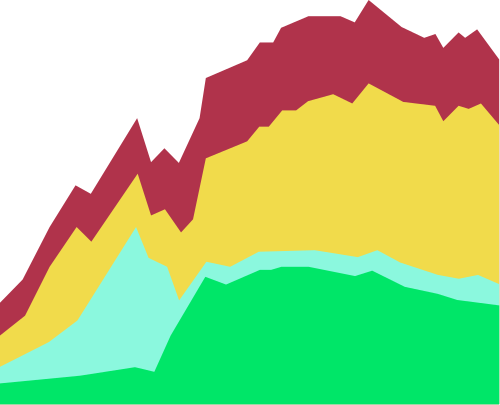
National Unit Sales by Flavor 2018 – 2023
In Millions USD
30
20
10
0
2018
2019
2020
2021
2022
2023
Tobacco-Flavored
Menthol
Mint
Clear/Other Cooling †
All Other Flavors†
E-Cigarettes Come in Multiple Device Types and Flavors
E-cigarettes were first introduced to the U.S. market in 2007.
The Vaping Epidemic in Adolescents – PMC (nih.gov)
Over the years, e-cigarettes have branched into several distinct product types,
including disposable devices (products intended to be disposed of completely once the
e-liquid reservoir is depleted), cartridge-based systems (heating devices sold
separately from prefilled cartridges that contain the e-liquid), and open systems
(products with tanks intended to be refilled via e-liquid bottles).
E-Cigarette, or Vaping, Products Visual Dictionary (cdc.gov)
In 2018, there were no actively enforced federal regulations for e-cigarettes within the
United States. As a result, all e-cigarette product types were available in a variety of
flavors. The major flavor categories tracked in our sales data include tobacco, menthol,
mint, all other flavors (including candy, fruit, beverages, desserts, spices), and
clear/other cooling (products marketed as being “clear” or unflavored but which likely
contain synthetic and/or menthol coolants).
Cardiovascular Health Effects and Synthetic Cooling Agents in E-cigarettes Labeled as ‘clear’ Marketed in Massachusetts After the Tobacco Product Flavoring Ban
Federal Enforcement Shifted Sales to Disposables
Effective February 2020, FDA prioritized enforcement of existing regulations against
prefilled cartridges in flavors other than menthol and tobacco. Subsequently, sales of
disposable e-cigarettes in mint and all other flavors and menthol prefilled cartridges
increased, while sales of prefilled cartridges in mint and other flavors ceased.
E-Cigarettes Have
Changed Greatly Over Time
Since 2020, e-cigarette
products have continued to increase in e-liquid capacity and nicotine strength and
incorporate a variety of modern technologies. Disposable products, which are available
in any flavor, are the most purchased e-cigarette product on the market today. Modern
disposable devices allow for significantly larger e-liquid capacity and higher nicotine
concentration compared to those sold at the time of the federal flavor policy
enforcement.
Trends in US E-cigarette Sales and Prices by Nicotine Strength, Overall and
by Product and Flavor Type, 2017–2022 – PMC (nih.gov)
In an effort to address youth e-cigarette use, several states and localities restricted
the sale of flavored e-cigarettes. Visit the “State E-Cigarette Sales Data” section of
this website, located below the “Retail Sales Data” tab, to explore state-level sales
data, as well as general policy descriptions and timelines where applicable.
Past Data Briefs
Issue 34: June 2026
New
Published October 2026
The data in this brief have been updated to capture new e-cigarette products coded by Circana (formerly IRI). Historical sales estimates may differ from previous briefs.
The data in this brief have been updated to capture new e-cigarette products coded by Circana (formerly IRI). Historical sales estimates may differ from previous briefs.
The data in this brief have been updated to capture new e-cigarette products coded by Circana (formerly IRI). Historical sales estimates may differ from previous briefs.
The data in this brief have been updated to capture new e-cigarette products coded by Circana (formerly IRI). Historical sales estimates may differ from previous briefs.
The data in this brief have been updated to capture new e-cigarette products coded by Circana (formerly IRI). Historical sales estimates may differ from previous briefs.
The data in this brief have been updated to capture new e-cigarette products coded by Circana (formerly IRI). Historical sales estimates may differ from previous briefs.
The data in this brief have been updated to capture new e-cigarette products coded by Circana (formerly IRI). Historical sales estimates may differ from previous briefs.
The data in this brief have been updated to capture new e-cigarette products coded by Circana (formerly IRI). Historical sales estimates may differ from previous briefs.
The data in this brief have been updated to capture new e-cigarette products coded by Circana (formerly IRI). Historical sales estimates may differ from previous briefs.
The data in this brief have been updated to capture new e-cigarette products coded by Circana (formerly IRI). Historical sales estimates may differ from previous briefs.
The data in this brief have been updated to capture new e-cigarette products coded by Circana (formerly IRI). Historical sales estimates may differ from previous briefs.
The data in this brief have been updated to capture new e-cigarette products coded by Circana (formerly IRI). Historical sales estimates may differ from previous briefs.
The data in this brief have been updated to capture new e-cigarette products coded by Circana (formerly IRI). Historical sales estimates may differ from previous briefs.
The data in this brief have been updated to capture new e-cigarette products coded by Circana (formerly IRI). Historical sales estimates may differ from previous briefs.
The data in this brief have been updated to capture new e-cigarette products coded by Circana (formerly IRI). Historical sales estimates may differ from previous briefs.
The data in this brief have been updated to capture new e-cigarette products coded by Circana (formerly IRI). Historical sales estimates may differ from previous briefs.
The data in this brief have been updated to capture new e-cigarette products coded by Circana (formerly IRI). Historical sales estimates may differ from previous briefs.
The data in this brief have been updated to capture new e-cigarette products coded by Circana (formerly IRI). Historical sales estimates may differ from previous briefs.
The data in this brief have been updated to capture new e-cigarette products coded by Circana (formerly IRI). Historical sales estimates may differ from previous briefs.
The data in this brief have been updated to capture new e-cigarette products coded by Circana (formerly IRI). Historical sales estimates may differ from previous briefs.
The data in this brief have been updated to capture new e-cigarette products coded by Circana (formerly IRI). Historical sales estimates may differ from previous briefs.
The data in this brief have been updated to capture new e-cigarette products coded by Circana (formerly IRI). Historical sales estimates may differ from previous briefs.
The data in this brief have been updated to capture new e-cigarette products coded by Circana (formerly IRI). Historical sales estimates may differ from previous briefs.
The data in this brief have been updated to capture new e-cigarette products coded by Circana (formerly IRI). Historical sales estimates may differ from previous briefs.
The data in this brief have been updated to capture new e-cigarette products coded by Circana (formerly IRI). Historical sales estimates may differ from previous briefs.
The data in this brief have been updated to capture new e-cigarette products coded by Circana (formerly IRI). Historical sales estimates may differ from previous briefs.
The data in this brief have been updated to capture new e-cigarette products coded by Circana (formerly IRI). Historical sales estimates may differ from previous briefs.
The data in this brief have been updated to capture new e-cigarette products coded by Circana (formerly IRI). Historical sales estimates may differ from previous briefs.
The data in this brief have been updated to capture new e-cigarette products coded by Circana (formerly IRI). Historical sales estimates may differ from previous briefs.
The data in this brief have been updated to capture new e-cigarette products coded by Circana (formerly IRI). Historical sales estimates may differ from previous briefs.
The data in this brief have been updated to capture new e-cigarette products coded by Circana (formerly IRI). Historical sales estimates may differ from previous briefs.
The data in this brief have been updated to capture new e-cigarette products coded by Circana (formerly IRI). Historical sales estimates may differ from previous briefs.
The data in this brief have been updated to capture new e-cigarette products coded by Circana (formerly IRI). Historical sales estimates may differ from previous briefs.
The data in this brief have been updated to capture new e-cigarette products coded by Circana (formerly IRI). Historical sales estimates may differ from previous briefs.
Suggested citation for interactive data visualizations:
CDC Foundation. (Date accessed). Title of Visualization. Available at: URL
Example citation for interactive data visualizations that can be updated by researchers:
CDC Foundation. (July 2026) National E-Cigarette Dollar Sales by Flavor. Available at: https://tobaccomonitoring.org/national/
Suggested citation for data briefs:
CDC Foundation. (YEAR). Monitoring U.S. E-Cigarette Sales: National Trends Data Brief. Issue Number, Month. URL.
Example citation for data briefs that can be updated by researchers:
CDC Foundation. (2021). Monitoring U.S. E-Cigarette Sales: National Trends Data Brief. Issue 01, October 2020. https://www.cdcfoundation.org/E-cigaretteSalesDataBrief?inline



 201820192020202120222023Tobacco-FlavoredMentholMintClear/Other Cooling †All Other Flavors†